SHARE
SHAREWhy integrated, architecture-level design – not standalone platforms – defines modern military superiority, and how IAI translates system-of-systems engineering into operational advantage
platforms no longer win wars. Architecture does.
The decisive advantage today lies not in a missile, radar, or UAV individually, but in how seamlessly these components operate together as a coherent, adaptive system-of-systems (SoS). As air and missile threats diversify, drone swarms proliferate, and electromagnetic environments become contested by default, integration has become the central engineering challenge of defence technology.
System-of-systems engineering addresses that challenge. It goes beyond basic interoperability to architect operational ecosystems in which sensors, effectors, command-and-control (C2), communications, and decision-support systems function as a synchronized, resilient whole—often across multiple domains. This architectural discipline is where IAI delivers differentiated value as a global leader in defence, aerospace, and security solutions.
From Platform-Centric to Architecture-Centric defence
For decades, procurement emphasized standalone performance: the fastest interceptor, the most sensitive radar, the longest-endurance UAV. Contemporary threat environments –characterized by saturation attacks, low-signature cruise missiles, loitering munitions, and electronic warfare – have exposed the limits of that model.
A layered air and missile defence engagement illustrates the shift. Detection may begin with space-based or over-the-horizon sensors, transition to ground-based AESA radar tracking, feed into battle management systems running real-time threat evaluation algorithms and culminate in kinetic or non-kinetic interception. Each node must operate within strict latency constraints and shared data standards. A breakdown in timing, data fusion, or network resilience can neutralize even the most advanced interceptor.
The competitive advantage therefore lies in controlling the architecture – not just the platforms.
Vertical Integration as Structural Advantage
When missiles, radars, C2 software, datalinks, and electronic warfare systems are developed within a unified industrial ecosystem, integration risk is significantly reduced. Interface standards, waveform compatibility, latency tolerances, and cybersecurity frameworks are aligned from inception under a common operational doctrine.
By contrast, assembling best-of-breed systems from disparate vendors often produces friction: proprietary interfaces, incompatible software baselines, export-control constraints, and misaligned upgrade cycles. The integration layer becomes a costly and potentially vulnerable patchwork.
System-of-systems engineering within a single enterprise enables native interoperability at the architecture level, synchronized upgrade In modern warfare, roadmaps, reduced integration overhead in export programs, and a unified cybersecurity posture. These structural advantages become decisive in multi-domain operations.
IAI’s Integrated Operational Framework
IAI’s multidisciplinary portfolio allows it to deliver complete operational frameworks, not isolated products. Its capabilities span advanced radar and electro-optical sensors, air and missile defence systems, precision-guided munitions and loitering weapons, unmanned aerial systems, satellite and space-based intelligence platforms, and naval combat systems.
This breadth enables holistic design optimization. Radar revisit rates can be calibrated relative to interceptor kinematics. Missile seeker logic can leverage specific radar waveforms. Battle management software can dynamically allocate resources across domains. These system-level efficiencies are achievable when sensors, effectors, and C2 are engineered as an integrated ecosystem rather than loosely coupled components.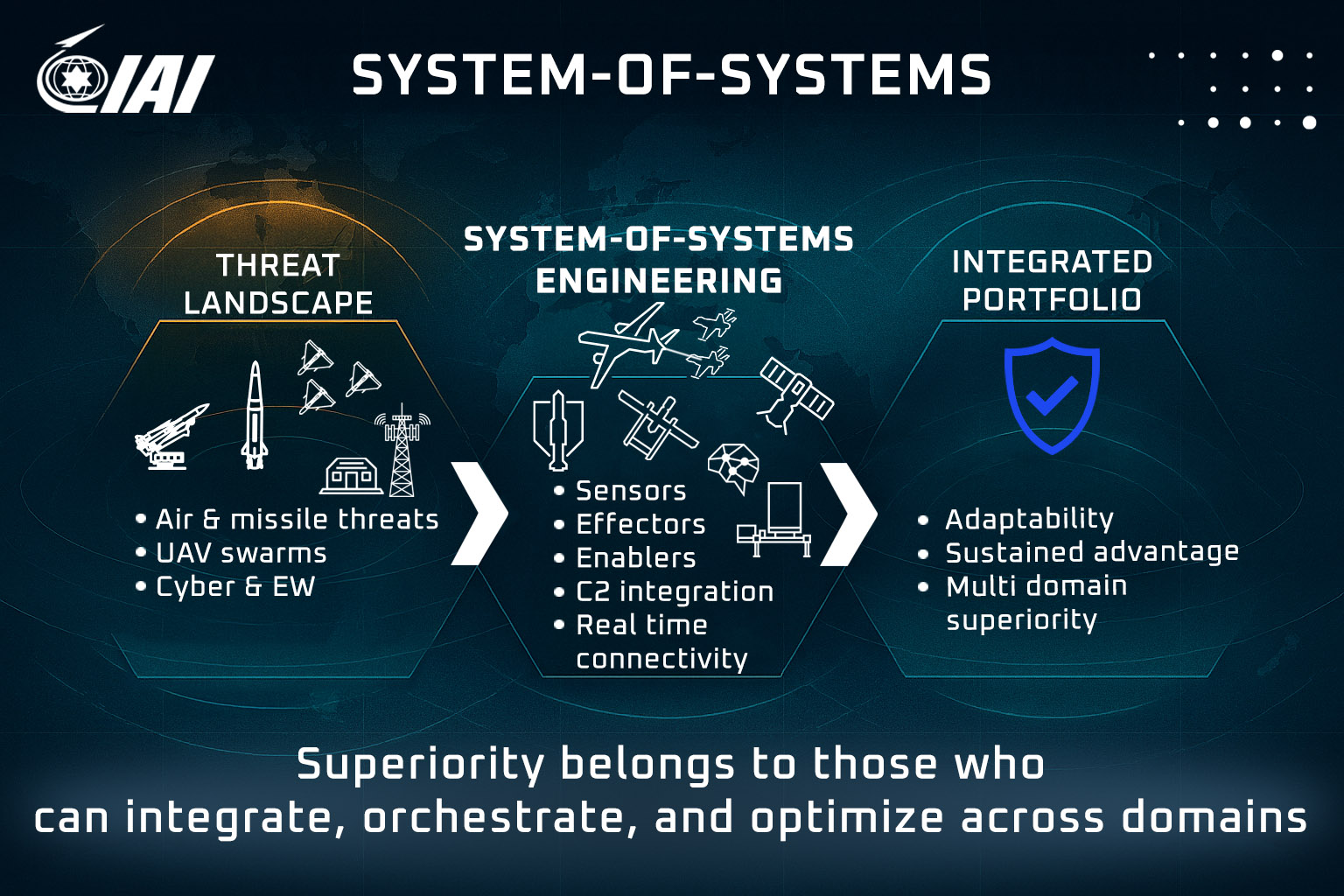
Generated by AI
Modular, Open, and Adaptable Architectures
defence customers operate under diverse constraints: legacy systems, evolving threats, budget pressures, and sovereignty requirements. Effective SoS solutions must therefore be modular and scalable.
IAI develops open-architecture frameworks that support third-party integration, incremental growth, interoperability with allied forces, and customization aligned with national doctrine. This approach preserves flexibility without sacrificing architectural coherence, enabling customers to develop capabilities while maintaining operational integrity.
Multi-Domain Integration and Rapid Adaptation
Modern defence architecture is inherently cross-domain. A maritime sensor may cue a land-based interceptor. An unmanned aerial system may relay targeting data to ground forces. Electronic warfare assets may shape the engagement environment before kinetic effects are employed.
Engineering these interactions requires more than connectivity. It demands distributed sensor fusion, synchronized timing frameworks, deterministic real-time networks resilient to contested electromagnetic conditions, and AI-assisted battle management capable of compressing decision timelines.
Recent conflicts have underscored another imperative: adaptation speed. Drone tactics, electronic warfare techniques, and missile profiles evolve rapidly. A vertically integrated system-of-systems portfolio enables rapid feedback loops. Software updates can propagate across sensors and interceptors. Electronic countermeasures can be refined based on operational data. Hardware refresh cycles can be sequenced without destabilizing the overall architecture.
In saturated threat scenarios – such as mixed salvos of ballistic missiles and low-cost UAVs – success depends on real-time resource allocation logic embedded in the architecture itself.
Architecture as the Decisive Capability
Increasingly, the export value proposition in defence is not a single system but an integrated, future-ready architecture aligned with national doctrine. Customers seek sovereign control, scalable layering, and long-term adaptability.
In this environment, the defence primes that masters system-of-systems engineering delivers more than equipment – it delivers operational coherence.
The most decisive capability in modern defence is often invisible. It resides in software layers, network topologies, integration frameworks, and architectural discipline. Platforms may capture attention, but it is the system-of-systems architecture – deliberately designed, natively integrated, and continuously evolved – that determines whether those platforms prevail.
IAI delivers comprehensive system-of-systems solutions that amplify the effectiveness of every component within the operational architecture, providing resilient, scalable, and mission-ready defence ecosystems for the challenges ahead.
Consult with an IAI Expert
Have a question or need more details?
Our specialists are here to help you find the right solution