SHARE
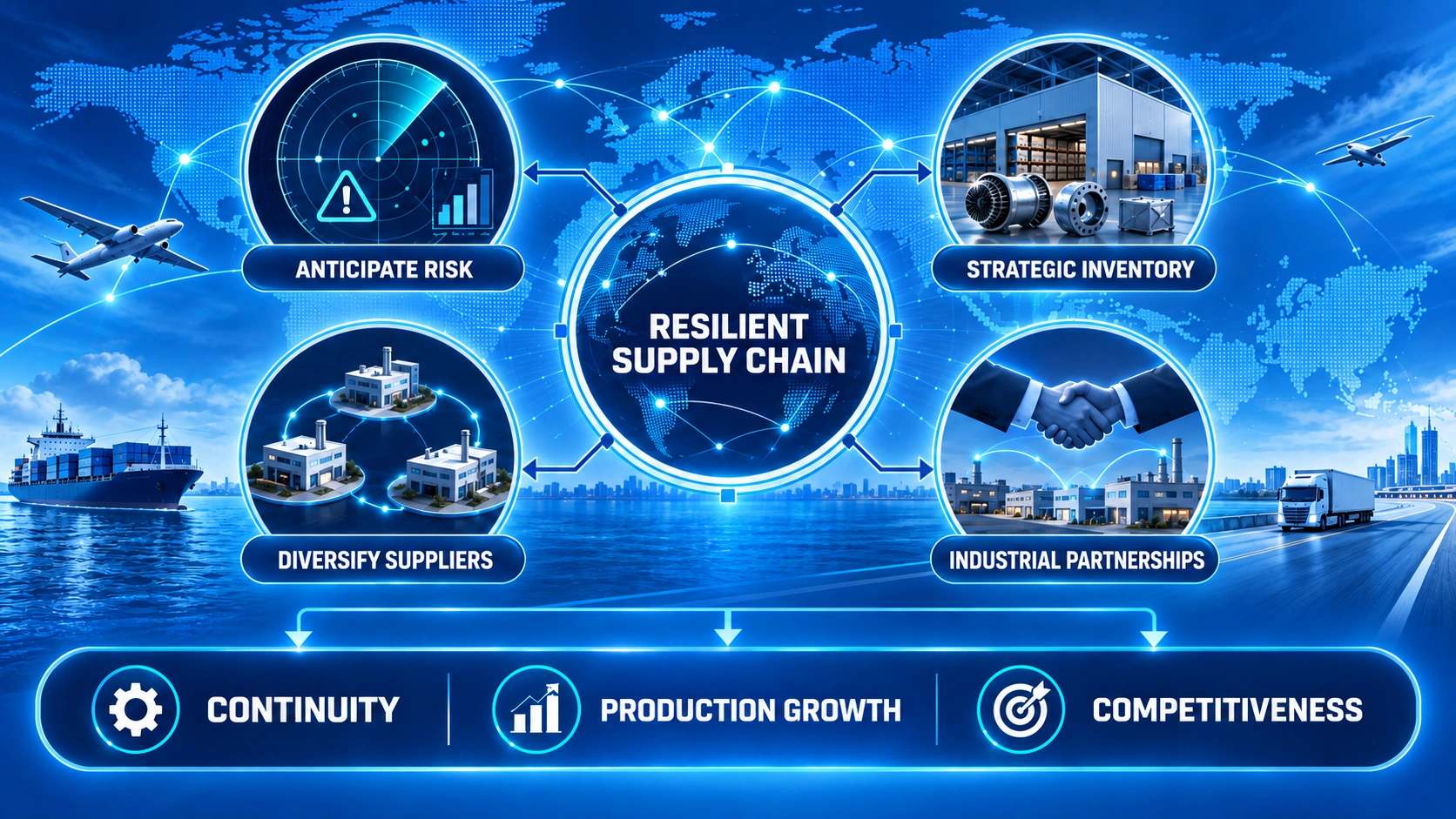
SHAREIAI is diversifying suppliers, strengthening strategic inventories, and expanding industrial partnerships to support continuity, production growth, and competitiveness.
Key Takeaways
- Supply chain resilience has become a permanent strategic capability, not simply an emergency response.
- Early risk identification, strategic inventories, and alternative sources help protect production continuity.
- Reshoring, friend-shoring, and industrial partnerships can broaden access to qualified suppliers.
- A broader supply base supports both customer commitments and long-term cost competitiveness.
Global aerospace and defence supply chains are under sustained pressure. Demand and production rates are rising while geopolitical disputes, transportation constraints, and limited sources for specialized materials and processes are increasing risk. For Israel Aerospace Industries (IAI), resilience also means maintaining business continuity during periods of regional conflict while continuing to meet commitments to customers worldwide. The central challenge is no longer responding to a single disruption. It is building a supply network prepared for several pressures at once.
The pressure has accumulated over several years. The COVID-19 pandemic disrupted international flights and maritime transport, while the war in Ukraine and other geopolitical strains affected resources, suppliers, and shipping capacity. Since October 7, 2023, geopolitical and transportation constraints have become even more significant for the Israeli industry. At the same time, rising global demand is placing further pressure on a highly specialized aerospace and defence supply base.
Preparing for Disruption Before It Happens
IAI has developed a multi-layered approach to identify risks early and reduce reliance on vulnerable sources. The company periodically reviews supply markets, considering geopolitical developments, supplier performance, transportation routes, financial factors, and production requirements.
This approach includes maintaining strategic inventories of selected raw materials and components, qualifying alternative suppliers, and establishing second sources where necessary. IAI is also reducing reliance on suppliers or regions where repeated difficulties could jeopardize continuity.
The company has invested approximately $150 million to develop and stabilize its supply chain, strengthening its ability to prepare for disruptions while increasing production.
Reshoring and friend-shoring provide two additional routes to resilience. The first builds capabilities closer to home; the second shifts sourcing and production toward reliable partners in countries that maintain strong, stable relationships with Israel.
India illustrates how supplier diversification can reinforce industrial partnership. IAI has long-standing activities and partnerships in the country and is working to expand its local supplier base. As Indian industry develops its aerospace and defence manufacturing capabilities, IAI is supporting efforts to improve supplier quality and performance to meet demanding industry requirements. Expanding this ecosystem can provide additional qualified sources while strengthening IAI’s position in an important market.
Keeping Production and Deliveries Moving
Supply chain resilience serves a clear operational purpose: keeping production lines active and ensuring that customers receive the systems and support they need.
During periods of conflict, IAI has continued operating while supporting Israel’s defense requirements and its international customers. Engineering teams, production facilities, and support operations have remained active, enabling projects and deliveries to proceed despite significant logistical and operational constraints.
Throughout the current war, IAI has avoided declaring force majeure and has continued working to meet its contractual commitments. This ability is supported by preparations made before a crisis, including inventory planning, alternative sourcing, and continuous assessment of transportation and supplier risks.
IAI’s aviation activities offer another example. During recent periods of regional instability, the company maintained operations both locally and at international sites. A global footprint, combined with significant in-house capabilities, helped reduce dependence on individual locations and subcontractors and provided additional operational flexibility.
A Broader Supply Base, a More Competitive IAI
Continuity is only part of the equation. Supply chain management must also support competitiveness. A substantial portion of a product’s cost can originate in the supply chain. As demand drives up the prices of raw materials and components, manufacturers must control costs while customers continue to expect competitive pricing, particularly as quantities increase.
Broadening the supplier base addresses both challenges. Additional qualified suppliers reduce the risk of a production line waiting for a critical component or subsystem. Greater sourcing flexibility can also improve competition and help manage costs.
For IAI, supply chain resilience is therefore not merely an emergency response but a continuing strategic capability. Preparation, diversification, and flexibility strengthen the company’s ability to maintain production, meet customer commitments, and compete in a market where disruption and rising demand increasingly occur together.
Consult with an IAI Expert
Have a question or need more details?
Our specialists are here to help you find the right solution