SHARE
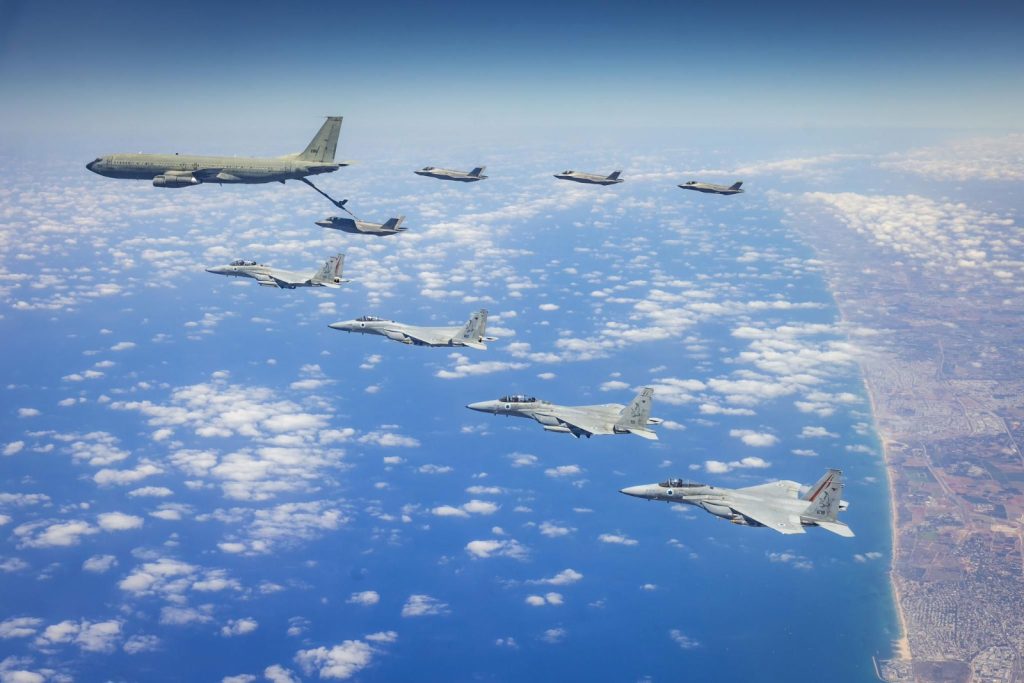
SHAREApproximately 5 million pounds of fuel have already been transferred in around 550 aerial refueling operations since the start of the Roaring Lion operation – more than twice the total number of refuelings carried out during operation Rising Lion
Lia Epstein, IDF Website
You have probably already seen the footage of aerial refueling over the skies of the Middle East, and heard the phrase:
“Disconnect. Cleared to exit right.”
You may even have been reminded of the iconic scene from the film Interstellar, where a spacecraft docks with the space station.
But beyond the cinematic atmosphere, behind this essential operation lies a precise technique, mastered by Squadron 120 (the Desert Giants).
“This is exactly the kind of mission our role was created for,” declares Major (Res.) A., a refueling pilot. “To enable the Air Force to operate continuously over long distances.”
So what exactly does he mean?
To understand the core of the matter, one must look at the numbers. Tehran, for example, is located approximately 1,900 kilometers from Israel – more than four times the length of the country – and the strike waves have already exceeded 13 at the time of writing this article.
In order to enable round-trip sorties to the Iranian capital, fuel is required – a great deal of it, even before mentioning the additional targets on the operational list.
“The entire procedure involves risk“
This is where Major (Res.) A. and his crew enter the picture:
two pilots, a navigator, a flight engineer, and a boomer (air refueling operator), operating a “Re’em” aircraft – a Boeing 707 tanker.
“In the first stage,” he explains, “the boomer, who sits in the rear section of the aircraft, guides us to the precise point in the sky where the refueling boom can connect to the receiving aircraft.”
The moment of contact between the tanker and the fighter aircraft is critical and must be completed quickly.
“The entire procedure involves risk,” the pilot emphasizes. “It requires intense concentration from every crew member, and it’s performed within the range of enemy threats. You can’t take your eyes off for even a moment, because there is no second opportunity – and the success of the entire mission depends on it.”
Once the connection is successfully established, the next phase begins: fuel transfer.
“The duration varies depending on the aircraft model, the required fuel quantity, and the size of the aircraft. Usually, the process takes a few minutes to complete, and the goal is always to keep it as short as possible.”
Despite the operational challenges, the Israeli Air Force has so far conducted approximately 550 aerial refuelings since the beginning of the operation, transferring about 5 million pounds of fuel – more than double the total number of refuelings carried out during the entire Rising Lion operation.
According to the deputy squadron commander, Major A., this surge did not happen by chance – it is the result of a plan that began immediately after the previous operation concluded.
“Since Rising Lion we’ve been asking ourselves: how can we fully maximize the tanker fleet? We streamlined mechanisms – from aircraft preparation before takeoff to the rate at which fuel flows through the boom. These are things that require precise physical calculations. That’s one of the reasons behind the expanded achievements this time.”
And when the crew lands at the end of a mission, as Major (Res.) A. describes, the sense of emotion is undeniable:
“In the end, this is why we’re here – this is our role in the campaign. Beyond the pride, it carries great meaning to take part and contribute to the fight. It’s something you truly understand only when you land back on the ground.”
Explore more IAI insights
Consult with an IAI Expert
Have a question or need more details?
Our specialists are here to help you find the right solution