When an air force can penetrate contested airspace, strike critical targets, and exit on its own terms, that is not symbolism – it is engineered control of the domain.
| Lior Benglas | IAMD operations expert – Air & Missile defence Systems | Over 30 years of senior operational and command experience in Israel’s air and missile defence, leading multi-layered defence ecosystems, system-of-systems integration, and high‑level interoperability programs
Air superiority is the difference between shaping events and reacting to them.
The first days of operation Roaring Lion operation have offered a clear example. When an air force can operate deep inside hostile territory, strike, and exit on its own terms, that is not symbolism. That is operational freedom.
Public reporting indicates that initial waves targeted elements that enable control of the air domain: air defence batteries, radar sites, and command-and-control nodes linked to missile forces. These are not headline-grabbing targets, but they are foundational. Degrading detection, disrupting coordination, and forcing defensive systems into reactive mode are what open corridors in contested airspace.
Only after that freedom of maneuver is established do other targets come into focus. Facilities in Natanz, Isfahan and Fordow associated with the nuclear programme, along with missile production and storage infrastructure, were reportedly struck once access had been created. That sequencing matters. Strategic sites become vulnerable only when the defensive envelope around them is weakened.
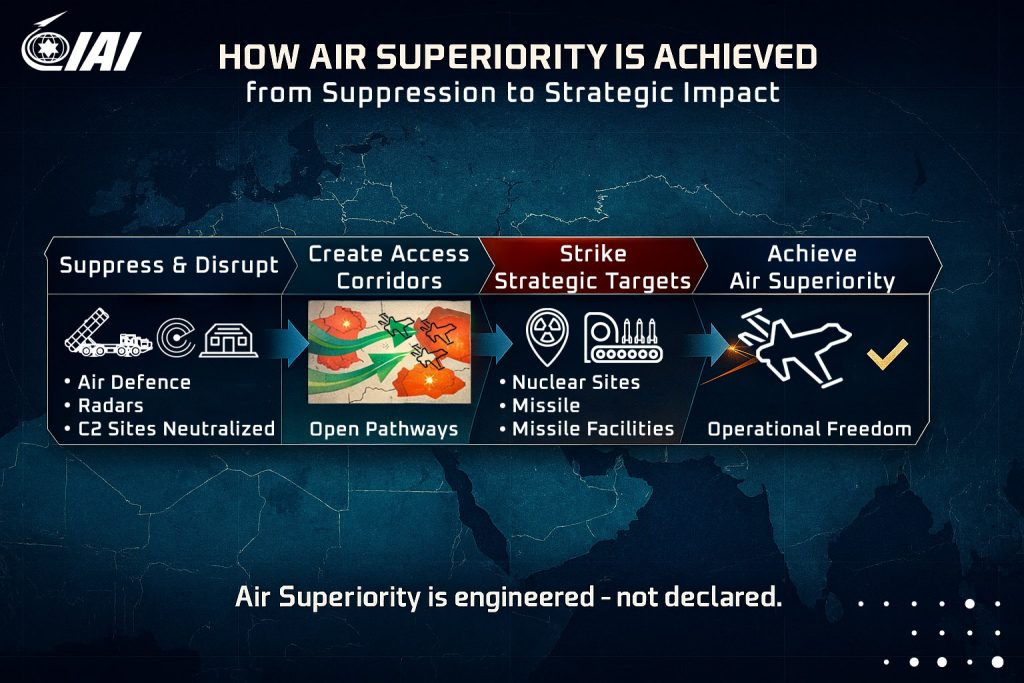
From my perspective, this is where air superiority moves from theory to practice. It is not declared. It is engineered through suppression, disruption, and sustained pressure.
The contrast with the Russia–Ukraine war remains instructive. There, neither side achieved durable control of the skies. Without that condition, operations grind forward slowly. With it,
strategic objectives can be pursued at a very different tempo. Air superiority does not guarantee victory. But it fundamentally changes what is possible.
Explore more IAI insights
Consult with an IAI Expert
Have a question or need more details?
Our specialists are here to help you find the right solution