SHARE
SHAREThe electromagnetic spectrum has emerged as a full-blown battlefield in modern warfare. Achieving dominance in this domain – superior electromagnetic sensing, intelligence and disruption – provides a critical advantage in both offensive and defensive operations
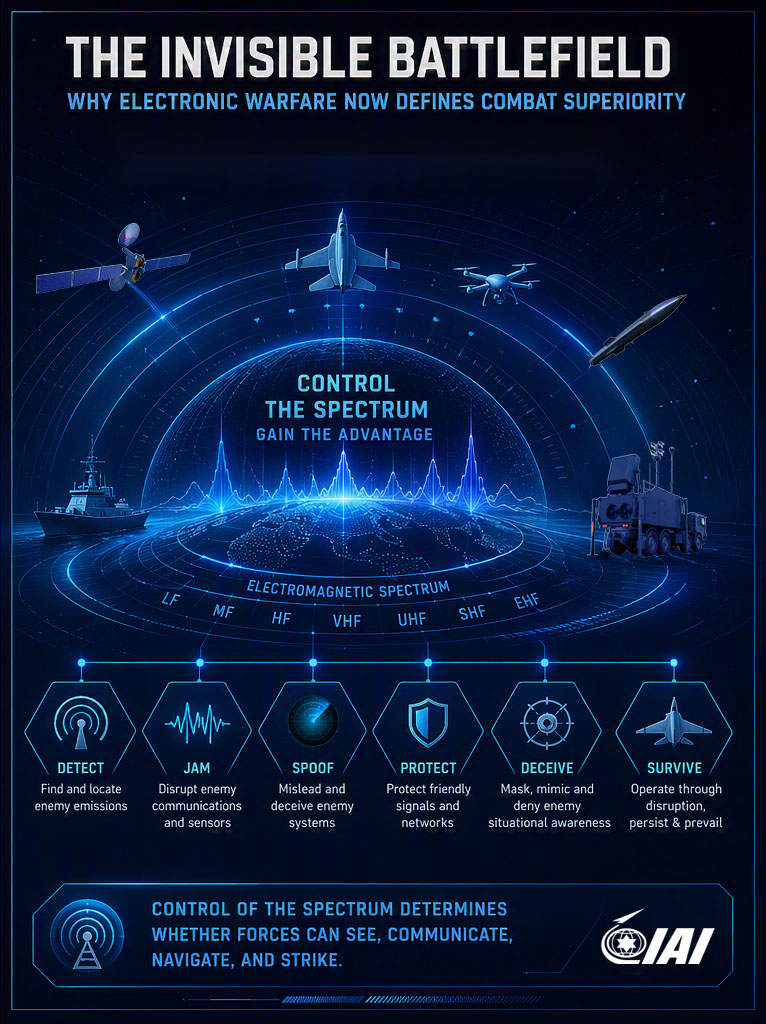
Electronic Warfare (EW) is the invisible battle surrounding the visible war of platforms and weapons – the struggle for dominance in the electromagnetic spectrum: sensing, disrupting, deceiving, and controlling the signals on which modern forces depend. Recent conflicts have demonstrated the significant operational advantages gained by forces that dominate the spectrum.
The battle over the electromagnetic spectrum begins long before platforms maneuver or kinetic weapons are launched. Modern warfare relies on radar, communications networks, satellite navigation, and secure data links – all dependent on electromagnetic signals. At the same time, forces exploit the enemy’s use of the spectrum to detect, locate, and understand its operations. Signals Intelligence (SIGINT) reveals the electronic order of battle: locating air defense radars through their emissions, monitoring communication networks, and exposing command-and-control links. Increasingly, AI-powered intelligence systems integrate large volumes of multi-sensor data, delivering actionable insights and real-time situational awareness to decision-makers.
Once hostile electromagnetic activity is detected and mapped, Electronic Attack (EA) capabilities are employed to disrupt enemy operations. EA systems can jam or deceive radars, disable communications and C2 networks, interfere with navigation signals, and degrade the sensing and data links of airborne threats such as UAVs and guided munitions. They can also suppress adversary intelligence collection by blinding sensors or overwhelming receivers with interference-forcing opposing forces to operate with degraded awareness and coordination. These actions rarely make headlines, yet they are decisive. By fragmenting command chains, degrading situational awareness, and introducing uncertainty, EW creates tangible operational advantage across the battlefield.
EW is becoming critical as unmanned aerial vehicles proliferate across modern battlefields. From small reconnaissance drones to long-range loitering munitions, UAVs are deployed in large numbers and at low cost, creating a mass threat that challenges traditional kinetic defenses. EW provides a uniquely scalable response – disrupting control links, navigation signals, and onboard sensing to neutralize large numbers of airborne threats simultaneously.
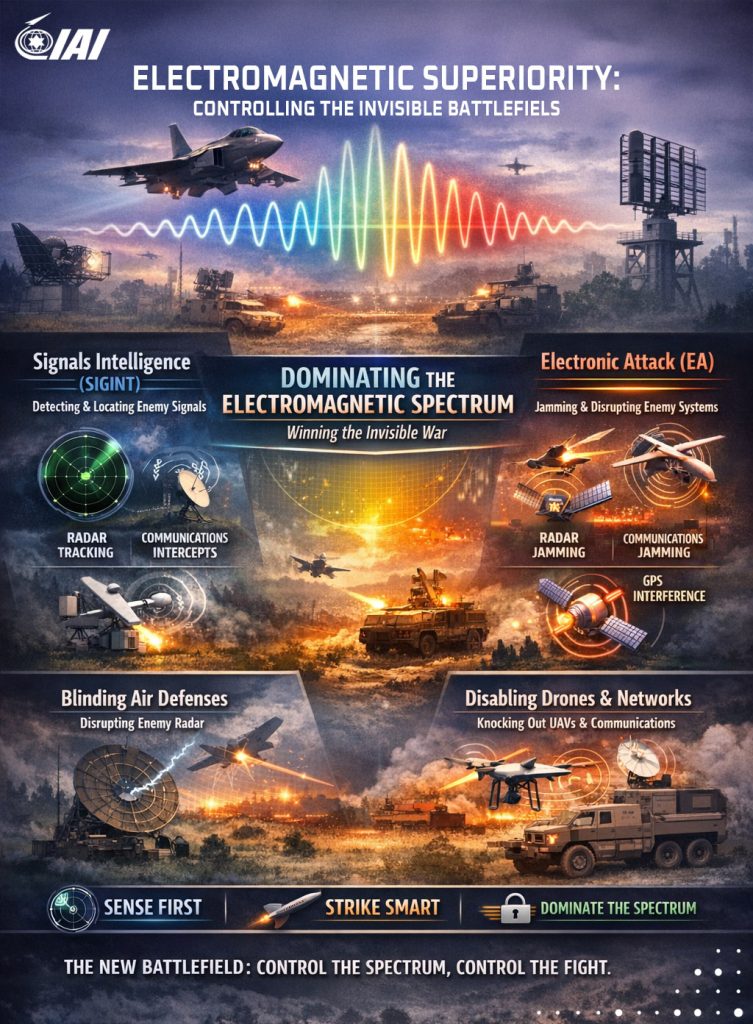
Core military functions – intelligence collection, precision targeting, coordinated maneuver, and integrated air and missile defense – depend on reliable access to and use of the electromagnetic spectrum. When these functions are disrupted, even technologically advanced forces struggle to operate coherently. This is where electromagnetic superiority becomes decisive. It is not declared – it is continuously achieved through sensing, intelligence, electronic attack, and persistent control of the spectrum.
Modern warfare is no longer just about firepower; it is increasingly about control of information in a contested spectrum. Electromagnetic superiority determines who can see first, understand faster, and act with coherence – while forcing the adversary into confusion, isolation, and degraded effectiveness. It underpins every core military function: sensing, decision-making, targeting, and coordinated maneuver.
In an era of proliferating UAVs, networked forces, and data-driven operations, electromagnetic superiority is no longer just a supporting capability; it provides a decisive edge in modern conflict.
Explore more IAI insights
Consult with an IAI Expert
Have a question or need more details?
Our specialists are here to help you find the right solution