SHARE
SHAREThe hot sun beats down on a rocky border area. Hidden among the rocks, a special forces team watches a house in a far-off village. They’ve been here for hours, waiting and watching. Suddenly, a low hum breaks the silence. The APUS 25 drone takes off, climbing high into the sky. In seconds, it’s too high to see from the ground. Time ticks by slowly. The soldiers stay still in their hiding spot, saving their energy. Up above, the APUS 25 keeps flying. Its cameras and sensors scan the area around the house, sending live video to the team below. As the day turns to evening, the drone’s night-vision cameras spot something new. There’s movement around the house. The team leader looks closely at the video feed. This is the information they’ve been waiting for. With this new intel, the soldiers get ready to move. Their mission is about to start. As night falls, the APUS 25 TactiQuad™ keeps flying, its long-endurance capabilities allowing it to watch over everything from high in the sky.
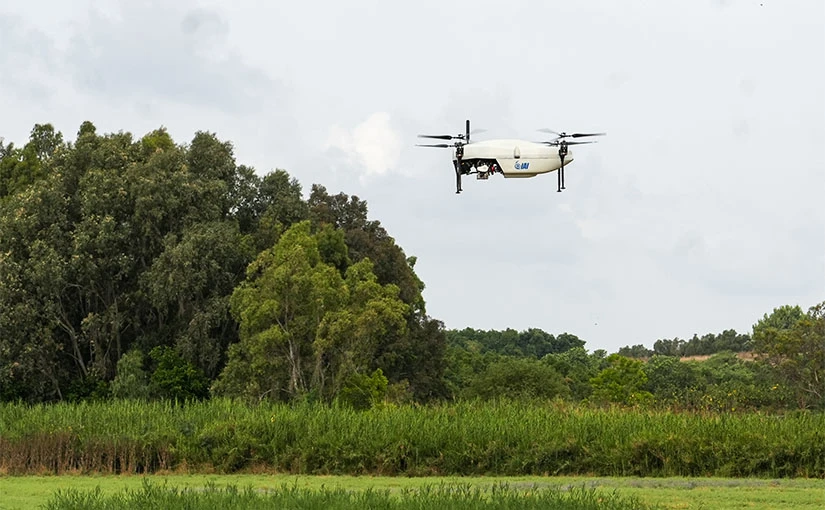
APUS 25
Long Endurance Quadcopter
Israel Aerospace Industries (IAI), Israel’s leading defence supplier, has unveiled a groundbreaking addition to its unmanned aerial systems portfolio – the APUS 25. This innovative long-endurance quadcopter is set to redefine tactical drone operations for ground and maritime forces worldwide. The APUS 25 represents a significant leap forward in drone technology, offering an unprecedented combination of vertical takeoff and landing (VTOL) capabilities with extended flight times typically asociated with fixed-wing aircraft. This unique blend of features addresses several critical pain points faced by military forces in the field.
At the heart of the APUS 25’s innovation is its propulsion system. Unlike conventional electric quadcopters that rely on multiple electric motors, the APUS 25 utilizes a single, centrally-located internal combustion engine. This engine operates at a fixed RPM, powering four rotors through a patented variable-pitch mechanism. The result is a dramatic increase in flight endurance – up to 8 hours, compared to the mere tens of minutes offered by electric counterparts. The use of a heavy fuel engine brings additional advantages. The APUS 25 can operate on various fuel types, including Jet-A1, JP5, and JP8, which are readily available in military supply chains. This eliminates the logistical challenges associated with battery-powered drones, such as long charging times and the need for specialized storage facilities.
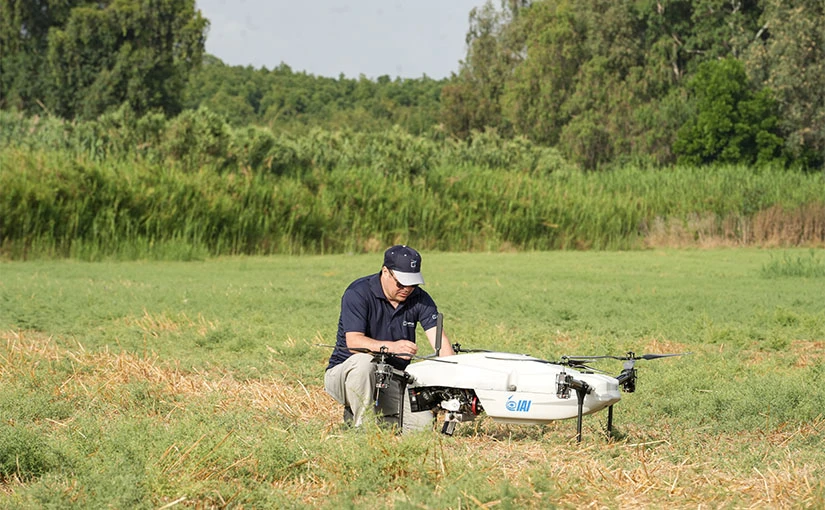
APUS 25
Long Endurance Quadcopter
In terms of payload capacity, the APUS 25 punches well above its weight class. With a maximum takeoff weight of just under 25 kg, it can carry payloads of up to 10 kg for extended missions. This opens up a wide range of possibilities for intelligence, surveillance, and reconnaissance (ISR) operations, as well as potential combat support roles. The drone’s advanced design allows it to operate effectively in challenging environments. It can withstand wind speeds of up to 23 knots and reach altitudes of 11,000 feet. The APUS 25’s maneuverability is particularly noteworthy, enabling it to perform tight turns and rapid changes in altitude – crucial capabilities for low-altitude flights and shipboard operations.
One of the most significant advantages of the APUS 25 is its ability to hover for extended periods. The liquid-cooled engine allows for prolonged stationary flight without the need for airflow cooling, a limitation often faced by fixed-wing VTOL drones. This makes the APUS 25 ideal for persistent surveillance missions or providing overwatch for ground troops. The drone’s compact size belies its impressive capabilities. Its small footprint allows for easy transport and deployment from a variety of platforms, including small naval vessels and tactical ground vehicles. This organic asset can be rapidly deployed by frontline units, providing immediate aerial support without the need for extensive launch infrastructure.
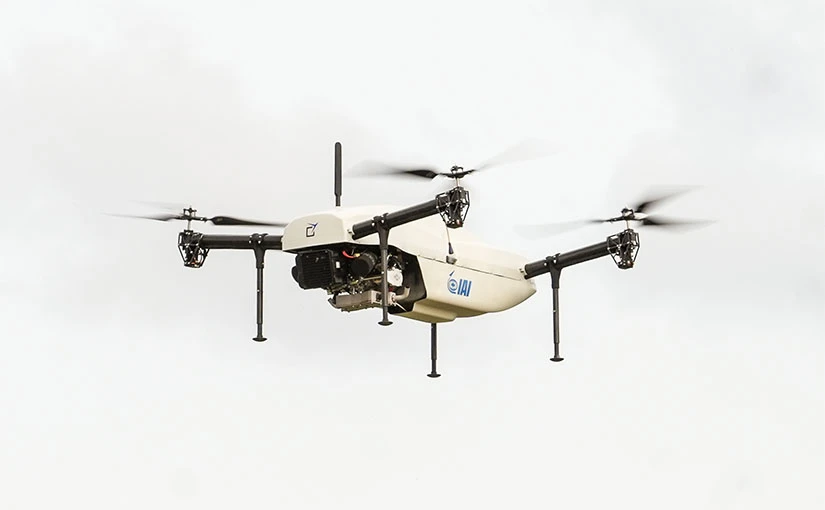
APUS 25
Long Endurance Quadcopter
IAI has designed the APUS 25 with versatility in mind. The drone can be equipped with a range of payloads, including high-resolution day/night cameras, laser designators, and specialized sensors for highly challenging tasks. The APUS 25’s versatility extends to offensive operations. The drone’s robust design and stable flight characteristics enable it to effectively deploy these weapon systems, adding a new dimension to tactical air support in combat scenarios.