SHARE
SHAREThe recent “Rising Lion” campaign – an intense 12-day military operation on an unprecedented scale – posed a formidable operational challenge for the Israeli Air Force (IAF). The complexity of sustained, multi-domain warfare, including deep strikes at extreme distances and rapid mission adaptation, demanded a level of performance and endurance beyond the capacity of conventional systems. Against this backdrop, IAI’s Heron family of Medium Altitude Long Endurance (MALE) unmanned aerial systems (UAS) emerged as a critical force multiplier, proving essential in achieving operational superiority in this high-tempo combat environment.
During the operations, the Herons carried out strategic missions at distances over 1,500 km from their home base and demonstrated their unique capabilities, including long-range surveillance, target identification, rapid closure of kill chains, and Battle Damage Assessment (BDA), enabled by advanced satellite communications and payload synchronization. The Herons formed part of the air force’s comprehensive, integrated operational framework by maintaining a continuous combat presence over Iran throughout the intensive 12-day campaign.
A critical component in these missions was high availability – the Heron squadron’s ability to maintain operational continuity while providing the flexibility to respond to developments in real-time, covering multiple operational focal points in various mission scenarios.
Availability & Flexibility
High availability with the extended unique performance of Heron platforms and its mission payloads underscores a unique strength of MALE platforms, performing missions which cannot be challenged by small and tactical UAS operating in the low-altitude domain.
MALE UAS, in particular the Herons are providing the necessary flexibility to support a range of missions, tactical and mostly strategic missions.
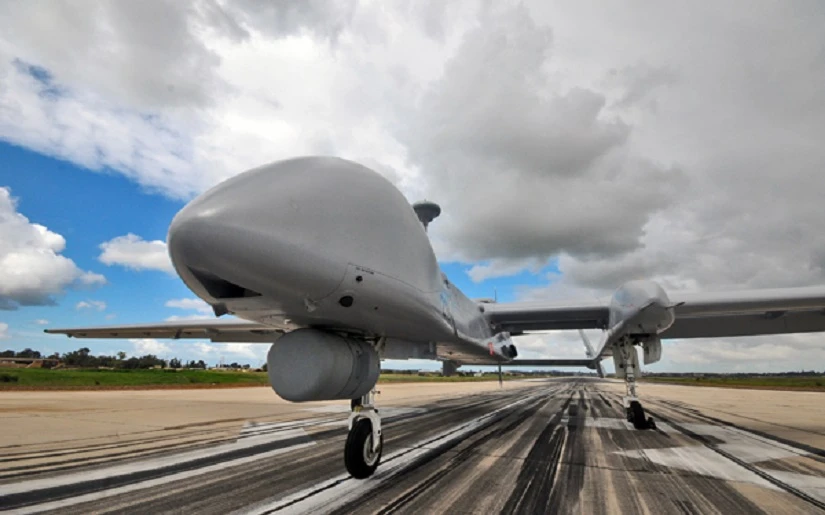
MALE platforms, including the Heron in its IAF version configuration (Shoval), and Heron TP (IAF’s Eitan), are specifically designed for extended missions at very long ranges, both stand-off and stand-in operations, as well as those within missile-defended areas. This capability is made possible through extended loitering capacity and integrated satellite communications.
Pic: IAF
Multi-Mission Versatility
On such long missions, the Herons were required to respond in real-time to unexpected situations and proved they can execute ad-hoc missions not previously planned. Intelligence gathering, terrain dominance, hunting of ballistic missiles and SAM, and routine maritime patrol were all standard missions the Heron family performed. During the operation, unique ad hoc missions were also executed, combining existing and new capabilities integrated with operational platforms, thanks to the flexibility and availability for which these platforms were designed.
The systems demonstrated extensive detection capabilities leveraging the entire IAI developed capabilities, including radar, wide-area surveillance, target identification and tracking, coverage of large areas of interest, surveillance of ground, sea and air domains and intelligence sharing.
A new benchmark for MALE UAS
Unlike the conflict in Ukraine, where UAS losses are staggering, and neither side successfully operates MALE UAS platforms, Operation Rising Lion showcases the full potential of MALE UAS systems when they are effectively integrated in mission planning and execution.
In such intensive combat operations, attrition is an integral part of operational planning and is measured in relation to mission accomplishment, rather than the number of aircraft lost. As the Heron family is concerned, while not all aircraft returned home, they successfully all missions were achieved. Israel’s defence officials expressed high satisfaction with the Heron family’s combat performance and its impressive capabilities, as well as the surprisingly low attrition ratios achieved.
IAI personnel supported the IAF Herons throughout the operations, responding to operational needs, maintaining maximum operational availability, and implementing new capabilities in short cycles—some of which were developed and integrated during active combat.
The Heron family’s performance in recent operations establishes a new benchmark for MALE UAS effectiveness in high-intensity combat. The combination of extended range, multi-mission capability, real-time response to evolving opportunities, low rate of attrition and integration with broader combat systems demonstrates why these platforms have become indispensable assets in modern military operations.