SHARE
SHAREThe modern battlefield demands more than individual aircraft, ships, or ground units operating in isolation. A lone fighter jet, no matter how advanced, cannot maximize its effectiveness if it lacks real-time connectivity with other assets in the operational theater. In today’s combat environment, seamless data sharing between fighter aircrafts, helicopters, UAVs, refueling tankers, naval vessels, and command centers is no longer an advantage—it is a necessity. IAI’s OPAL system provides this missing link, transforming disparate military platforms into a single, intelligent combat force.
A Tactical Cloud Connecting the Entire Fleet
OPAL is a real-time decentralized networking system designed to integrate all combat platforms into a shared operational picture. Rather than relying on rigid, pre-defined data links, OPAL enables every asset—airborne, naval, or land-based—to function as an information node in a self-sustaining tactical cloud. This connectivity ensures that all relevant data is processed, filtered, and shared instantly, allowing commanders and pilots to make split-second decisions based on the most accurate intelligence available. For example, an F-16 tracking a hostile UAV may lack the means to neutralize the threat, but with OPAL, it can instantly transmit the target’s coordinates to a nearby missile corvette or ground-based air defence unit, which can engage with pinpoint accuracy. Without OPAL, such a scenario would require verbal coordination, reliance on multiple interfaces, and potential delays that could compromise mission success.
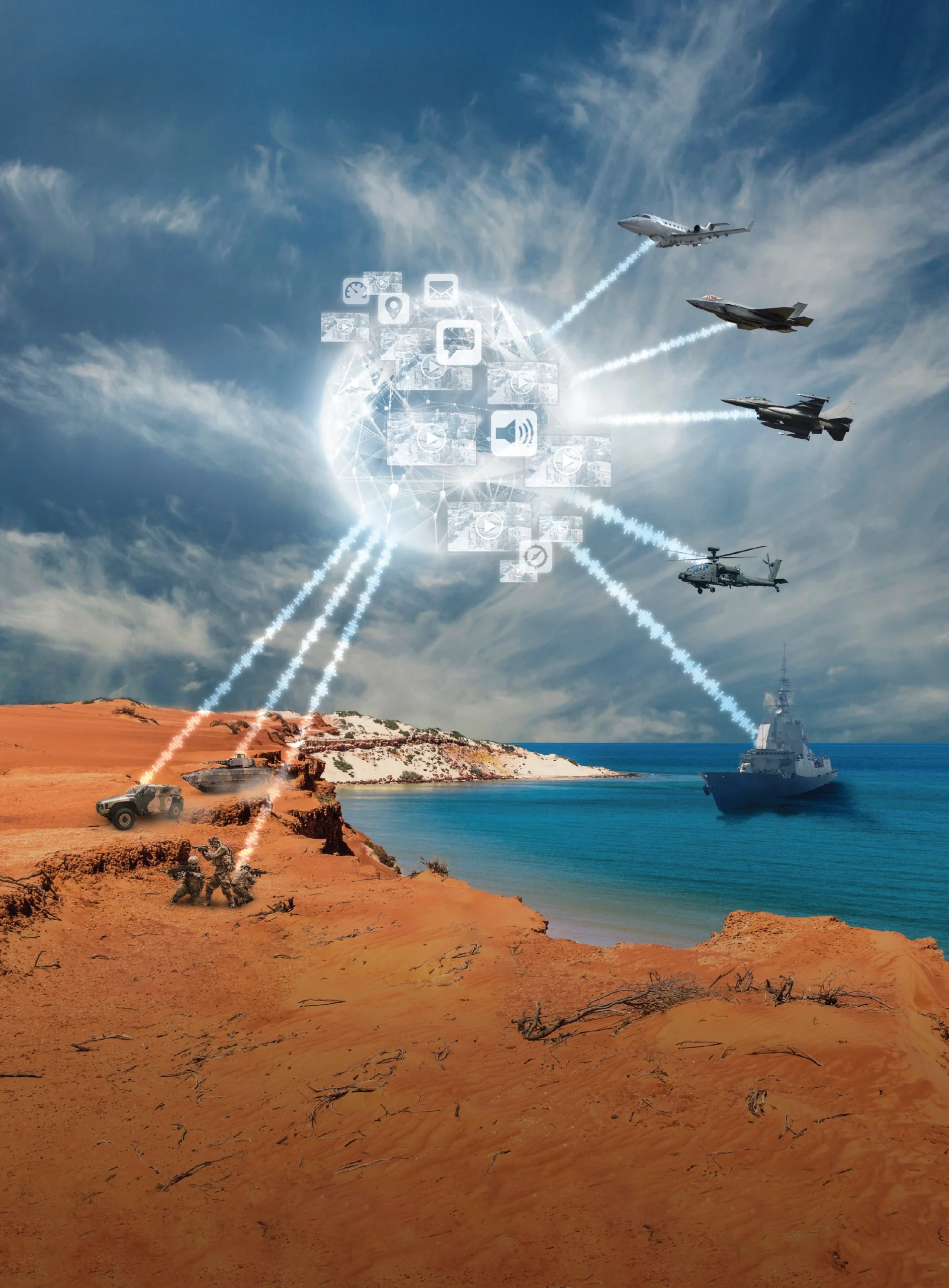
OPAL – Decentralized, Airborne Networked Battle Management
Seamless Multi-Platform Integration
What sets OPAL apart is its ability to work across a wide range of military platforms, regardless of generation, manufacturer, or role. Whether integrating F-35, F-16, and F-15 fighters, Apache helicopters, UAVs, or naval missile ships, OPAL ensures that all assets communicate effortlessly. It allows forces to expand their network gradually, integrating select squadrons, fleets, or ground units first and then scaling up without disrupting existing infrastructure.
This scalability is particularly critical for military forces operating mixed fleets, where different generations of aircraft and ships must collaborate. OPAL’s open architecture means that even older aircraft and naval vessels can be quickly configured to share information with next-generation platforms, avoiding costly overhauls and extending the lifespan of legacy systems.
Extending Beyond Link-16: Coalition and Joint Operations
In coalition warfare, interoperability is often a challenge, as different nations use distinct communication networks. Link-16 is the standard NATO data link, but not all platforms are equipped with it. OPAL does not seek to replace Link-16 but rather to enhance and complement it.
By bridging communication gaps, OPAL allows non-Link-16 platforms—such as helicopters, UAVs, and select naval vessels—to participate in joint operations alongside Link-16-enabled assets. This is achieved through advanced bi-directional gateway, which translates and synchronizes messages, ensuring that all forces—regardless of their native communication systems—can operate as a single, coordinated force. UAV conducting reconnaissance over a conflict zone can transmit critical intelligence not only to its home network but also to allied NATO forces operating under Link-16. Similarly, a helicopter lacking Link-16 capability can still receive mission-critical updates from coalition air assets. This ability to merge independent networks into a unified battle space is a game-changer for multinational operations.
Moreover, OPAL can fuse and correlate data coming from Link-16 network with other ownship sensor information to display to the pilot and more accurate and up-to-date mission information, and in addition distribute this new data entity onto the networks.
Reducing Complexity for Operators
Modern cockpits and command centers are flooded with information. Pilots and operators must sift through multiple displays, sensors, and communication feeds, often in high-pressure combat environments. OPAL simplifies this process by applying advanced data fusion algorithms that prioritize and refine incoming intelligence, presenting pilots with a clear, actionable picture.
Instead of manually processing five different screens with various data streams, OPAL ensures that only the most relevant tactical insights are displayed, allowing pilots and operators to focus on the mission rather than the interface. This capability is particularly critical in high-speed aerial engagements, naval strike coordination, and real-time battlefield command.
Scalable and Cost-Effective Deployment
One of OPAL’s greatest strengths is its low barrier to entry. Unlike traditional full-fleet upgrade programs, OPAL can be deployed incrementally, allowing forces to test and refine the system within select units before expanding fleet-wide. defence organizations can install OPAL on a single squadron, UAV fleet, or naval task force, evaluate its impact, and gradually scale up deployment without disrupting operations. This phased approach ensures cost-effective modernization and allows flexibility in fleet management, as different branches of the military can integrate OPAL at their own pace. Furthermore, OPAL’s architecture supports integration with future technological advancements, ensuring that military fleets remain at the cutting edge without requiring continuous overhauls or major platform replacements.
A Connected Combat Force
The future of military operations is not about individual platforms but about how effectively they work together. OPAL provides this crucial battlefield connectivity, ensuring that every aircraft, helicopter, UAV, naval vessel, and ground unit operates within a unified combat network. By enabling seamless multi-platform integration, enhancing coalition interoperability, and simplifying data management for operators, OPAL delivers a decisive operational advantage.
In a world where combat effectiveness depends on real-time information sharing, OPAL transforms military forces into a smarter, faster, and more connected warfighting machine.