SHARE
SHAREAs military forces become increasingly dependent on connectivity, the fight for control of the electromagnetic spectrum is emerging as a decisive factor in modern warfare
Tzachi Biran
Key Takeaways:
-
- Spectrum dominance is operational dominance
- EW is a frontline force multiplier
- Adaptation beats technology alone
- Future forces must fight through disruption
The first battle of modern warfare often begins without a shot being fired. It begins in the electromagnetic spectrum – where forces fight to see, communicate, navigate, target, deceive, and survive. In this invisible battlespace, electronic warfare is no longer a supporting capability. It is becoming a front line of its own – and a force multiplier for forces that must operate under disruption.
The Spectrum Becomes Contested Terrain
Every modern military capability depends on electromagnetic access. Drones require control links, video transmission, and navigation. Precision weapons rely on guidance signals. Commanders depend on communications. Sensors include reconnaissance and air-defense radars and fire-control radars deployed on naval, uncrewed, and airborne platforms, as well as land-based systems. Networked forces need connectivity to operate as a system.
That dependency creates vulnerability. If an adversary can jam, spoof, intercept, locate, or deceive signals, it can degrade an entire operational architecture without destroying a single platform. A drone that loses its link becomes ineffective. A precision weapon that loses navigation becomes uncertain. A command network that cannot trust its data becomes slow, fragmented, and exposed.
This is why the electromagnetic spectrum has become decisive terrain. It is not separate from maneuver, firepower, or intelligence. It enables all three. In a system-of-systems (SoS), EW is a main enabler of coherence, allowing distributed sensors, platforms, networks, and command nodes to operate as a coordinated force under contested conditions.
Ukraine and the Adaptation Race
The war in Ukraine has shown how quickly electronic warfare can reshape battlefield advantage. Drones that initially created enormous tactical impact have increasingly faced dense jamming, GPS disruption, signal interception, and counter-drone systems. Both sides have adapted rapidly, changing frequencies, modifying guidance methods, developing more resilient communications, and experimenting with systems that reduce dependence on vulnerable links.
This has created a cycle of continuous adaptation. A new drone capability appears. Countermeasures emerge. Operators modify tactics. Engineers adjust software and hardware. The battlefield becomes an accelerated development environment.
The key lesson is clear: electronic warfare is not a fixed capability. It is a dynamic contest. Superiority belongs to the side that can adapt faster across technology, tactics, and operational doctrine.
From Support Function to Operational Core
Historically, electronic warfare was often treated as a specialist function. Today, that approach is no longer sufficient. EW must be embedded into every layer of force design, from tactical maneuver to national air defense.
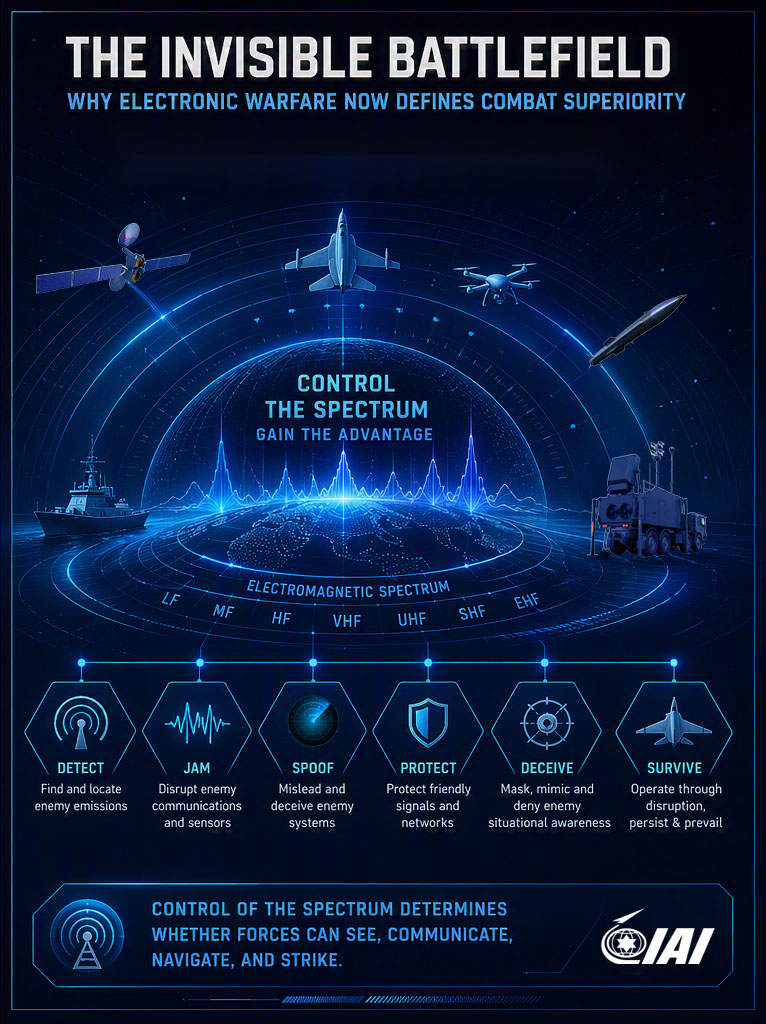
Modern forces require integrated electronic capabilities that can:
- Protect friendly communications and navigation in GPS-denied and communications-disrupted environments.
- Detect and locate enemy emitters to support intelligence, targeting, and maneuver.
- Disrupt hostile drones and precision weapons before kinetic interception is required.
- Deceive adversary sensors and command systems through spoofing, masking, and signature management.
- Enable spectrum awareness so commanders understand which signals are active, contested, degraded, or compromised.
- Support multi-domain operations by linking EW with cyber, air defense, intelligence, and command-and-control systems.
When EW is integrated this way, it becomes more than defense. It becomes a tool for shaping the battlefield.
The Arabian Sea and the Problem of Saturation
The Arabian Sea conflict has highlighted another dimension of the spectrum fight: saturation. Naval forces facing drones, missiles, UAV swarms, and robotic or autonomous platforms must operate in an environment where detection, classification, and response timelines are compressed. The rise of drone swarms and autonomous threats intensifies this challenge, because the threat is no longer only individual objects but large, distributed, and adaptive formations. Electronic sensing, emissions control, soft-kill measures, and layered defense all become part of the same operational equation.
In such scenarios, the value of EW lies not only in defeating individual threats. It lies in reducing the burden on kinetic systems, preserving interceptor inventories, complicating adversary targeting, and giving commanders more decision space.
Against low-cost mass threats, this matters profoundly. The future of defense cannot depend only on firing expensive interceptors at every incoming object. It must combine hard-kill, soft-kill, deception, intelligence, counter-autonomy, and rapid prioritization.
Designing for the Invisible Fight
Electronic warfare must now be treated as a design principle. Platforms should be built to operate under interference. Networks should assume degradation. Sensors should be fused to compensate for deception. Command systems should function even when connectivity is partial. Robotic and autonomous platforms should be resilient to navigation denial, signal loss, and adversarial deception.
The forces that succeed will not be those that assume a clean electromagnetic environment. They will be those designed for a dirty one.
The Battle Before the Battle
The future battlefield will be shaped by missiles, drones, armored forces, aircraft, ships, and satellites. But before these systems can perform, they must first win access to the spectrum.
Electronic warfare is the battle before the battle – the precondition for battlefield superiority that determines whether forces can see, communicate, navigate, and strike. In an age of connected warfare, controlling the invisible domain may decide the visible outcome.
Consult with an IAI Expert
Have a question or need more details?
Our specialists are here to help you find the right solution